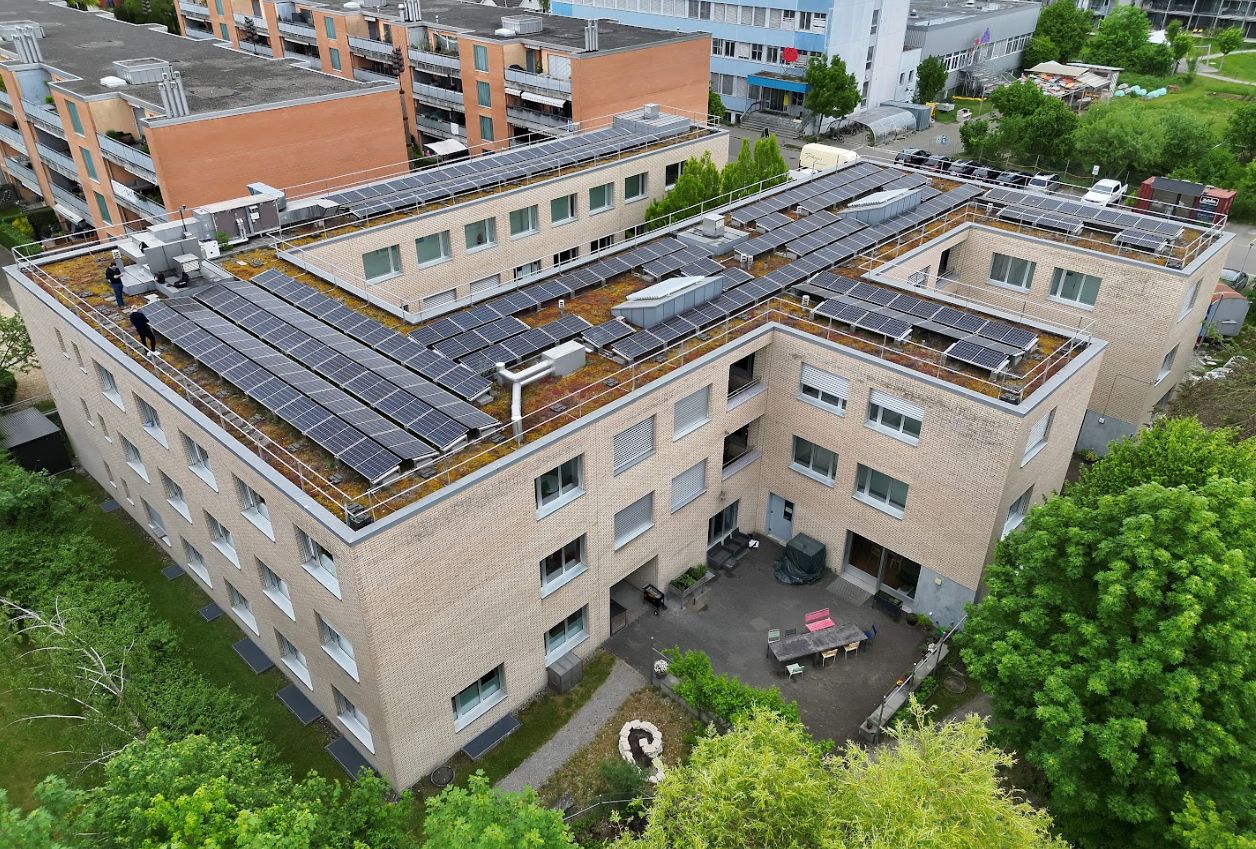
Winterthur pilot project: vZEV/RCPv, BESS peak shaving and LEG/CEL combined
From an existing plant to a pilot installation
The Winterthur installation is not a new-build project. It has been supplying clean, low-cost electricity to Modellstation SOMOSA since 2021 – a classic contracting asset of the kind Sundust operates many times over.
With the new «Mantelerlass» energy law revision, the Swiss legislator introduced two new instruments in quick succession: the virtual self-consumption community – virtueller Zusammenschluss zum Eigenverbrauch (vZEV) in German, regroupement virtuel dans le cadre de la consommation propre (RCPv) in French – available since the beginning of 2025, and the local electricity community – Lokale Elektrizitätsgemeinschaft (LEG) in German, communauté électrique locale (CEL) in French – available since the beginning of 2026. Implementing vZEV/RCPv and LEG/CEL for commercial participants with differing tariff structures is demanding in itself. Combining the two while also operating a battery storage system economically is the maximum level of complexity. Sundust deliberately chose to implement this constellation at an existing site as a proof of concept – and to roll it out across Switzerland from there.
Four building blocks
Virtual self-consumption community (vZEV/RCPv). Solar electricity is allocated to several electricity customers on a balance-sheet basis via a virtual metering point. No physical direct lines between the buildings are required – the electricity flows through the distribution grid as usual, and the allocation is calculated from smart meter data. Several buildings therefore share low-cost solar electricity while each consumer remains an independent market participant.
Commercial participants with differing tariff structures. This is where the real difficulty lies. The vZEV/RCPv brings together companies that are independent of one another. They have different electricity tariffs and are priced differently: some participants are billed on a capacity tariff, others are not. The standard case in the market is a vZEV/RCPv made up of residential customers. A vZEV/RCPv that cleanly integrates participants with different price profiles and partly capacity-based billing is not. Sundust has set the case up so that an appropriate solar tariff can be defined for each individual participant – the precondition for commercial customers to share the same solar electricity fairly and transparently.
Peak shaving with battery storage (BESS). A battery system caps the load peaks on site and relieves the grid. The resulting reduction of the monthly peak load varies seasonally and is in the order of 50 percent. For customers on a capacity tariff this is a direct cost lever, because their grid costs depend largely on the highest capacity drawn – not on the energy volume alone. At the same time, the battery increases the self-consumption rate of the PV installation.
Connection to the local electricity community (LEG/CEL). Solar electricity that is not consumed within the vZEV/RCPv is not simply fed into the grid at the feed-in tariff. It is delivered into the neighbourhood through a LEG/CEL operated by Stadtwerk Winterthur – local solar supply at reduced grid usage tariffs. The vZEV/RCPv is therefore itself a participant in a higher-level community.
Why the combination is demanding
Each of these building blocks comes with its own requirements for the metering concept, data quality and billing logic. Combined, they interact: the battery influences how much electricity is balanced within the vZEV/RCPv; the balancing within the vZEV/RCPv determines how much solar electricity remains for the LEG/CEL; and the participants' differing tariff structures decide how the benefit from peak shaving and self-consumption is distributed. Anyone who does not master this chain end to end will produce either invoices that do not add up, or a business case that stays on paper.
The Winterthur pilot shows that Sundust has this chain under control – from system design and technical implementation through to recurring billing in live operation. The storage system was installed together with our realisation partner CKW Gebäudetechnik AG.
Why Sundust does this as a "contractor"
The energy transition has become complex. New models such as vZEV/RCPv and LEG/CEL open up real savings potential, but they require investment, regulatory know-how and the willingness to carry operating and billing risks. Sundust takes exactly this complexity off our customers' hands: we invest in integrated energy solutions, operate them over the contract term and carry the financial and regulatory risks. Our customers benefit from lower energy costs – without any investment burden of their own.
The Winterthur pilot is therefore more than a technical reference. It is the proof that existing installations can be developed consistently into proactive energy systems through smart energy contracting.
Your site, your case
Do you operate a property with several users, high load peaks or unused roof potential? Or do you have an existing PV installation that could do more than it does today? We will review your situation and show you which combination of self-consumption, storage and local electricity supply makes economic sense at your site.
Get in touch with us at www.sundustgroup.com